
California Voter Registration Lookup
The official My Voter Status service is the first stop for a voter checking their own record. Enter the identity details as they appear on the registration. The service can report registration status, political party preference, election-material language, ballot status, polling place or vote center, the county election office, and election-result links. Because the form authenticates one voter, it is not a public name index.
| Lookup entry | Input kind | Needed | How California uses it |
|---|---|---|---|
| First name | Text | Yes | Enter the name as registered. |
| Last name | Text | Yes | Enter the name as registered. |
| Date of birth | Date | Yes | Helps authenticate the voter. |
| California driver license or ID | Text | Conditional | Used when the voter has a state-issued number. |
| Last four SSN digits | Text | Conditional | Alternate verification when applicable. |
| Search or submit | Button | Yes | Returns voter-specific status after a match. |
Start at the state tool, then use the displayed county election office when a status or ballot issue needs local review. A person who has moved or needs a new record can instead use California's registration service. This sequence keeps a routine check apart from the restricted voter-file process.
The state lookup screen shows the secure entry point used for this self-check.
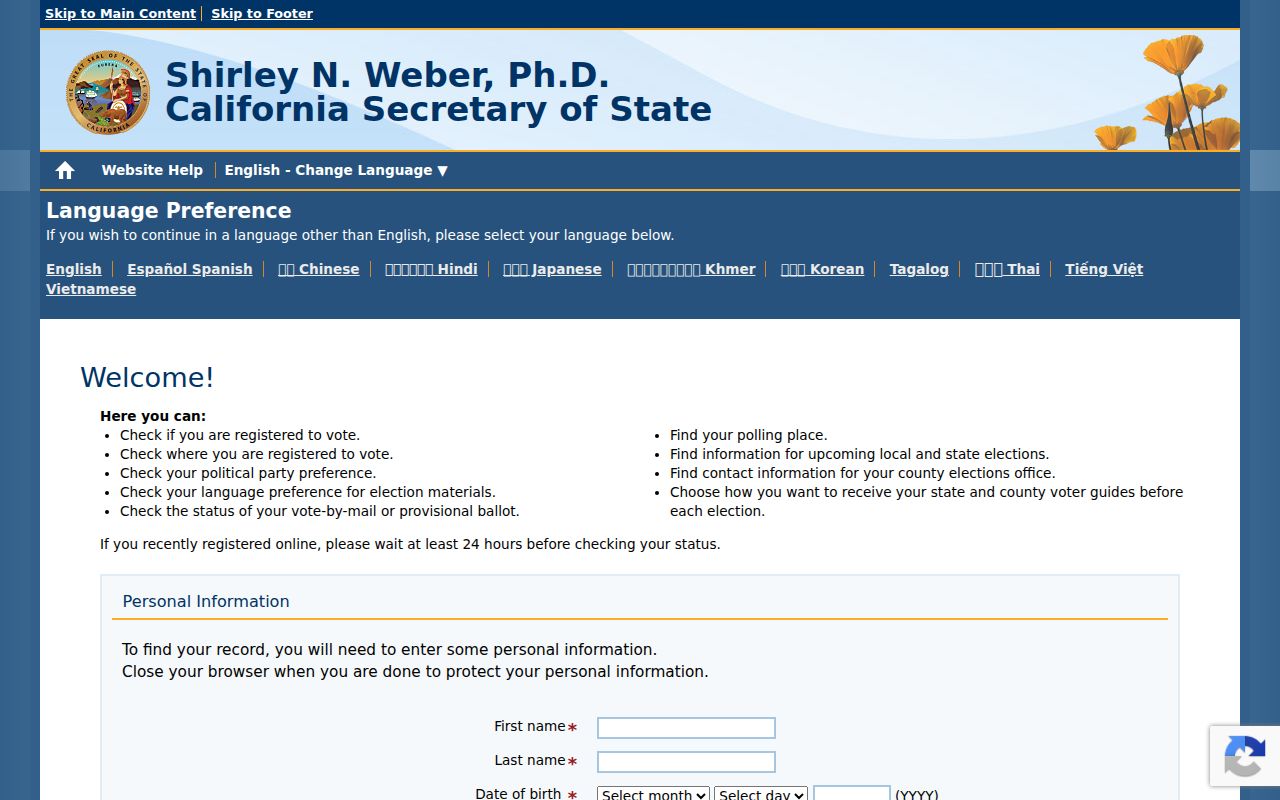
The identity fields explain why the screen can confirm one person's status without opening California voter rolls for casual browsing. A failed match should go to the county election office for review.
Register or Update in California
Checking a record and changing it are different tasks. The California Online Voter Registration service handles a new registration or an update after a move, name change, or party-preference change. It feeds the election system rather than serving as a public records search. The voter should use current, accurate details and follow the service's own prompts.
The source registration page is shown below so readers can distinguish it from My Voter Status.
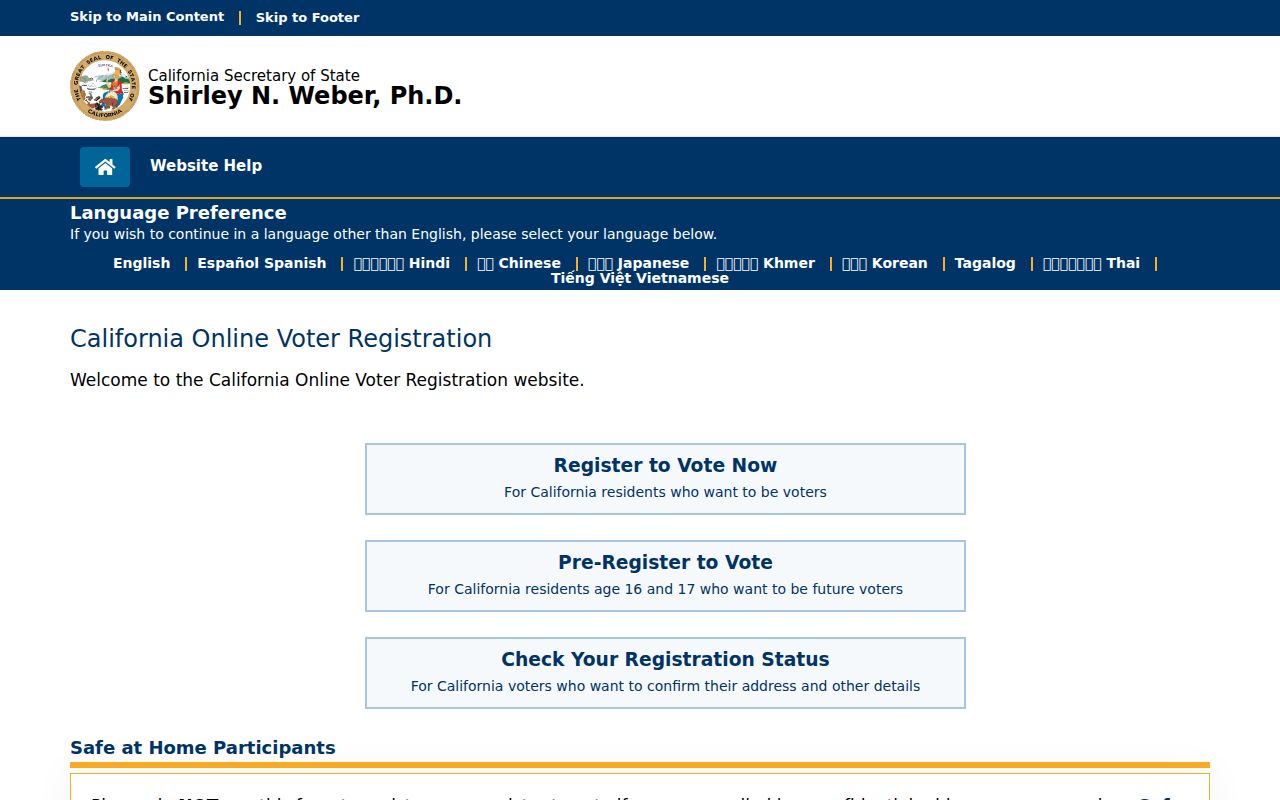
This screen begins the registration workflow; it does not display another voter's file or expose a statewide voter list.
VoteCal Links California Voter Records
VoteCal is California's centralized voter registration database. It links the statewide system with county election-management systems, while My Voter Status provides the resident-facing check. This distinction matters: VoteCal is the system of record, not an open public people finder. County officials still manage local registration work and remain the practical contact when a voter needs help with a county-held detail.
The Secretary of State's VoteCal project overview gives the official context for the statewide database.
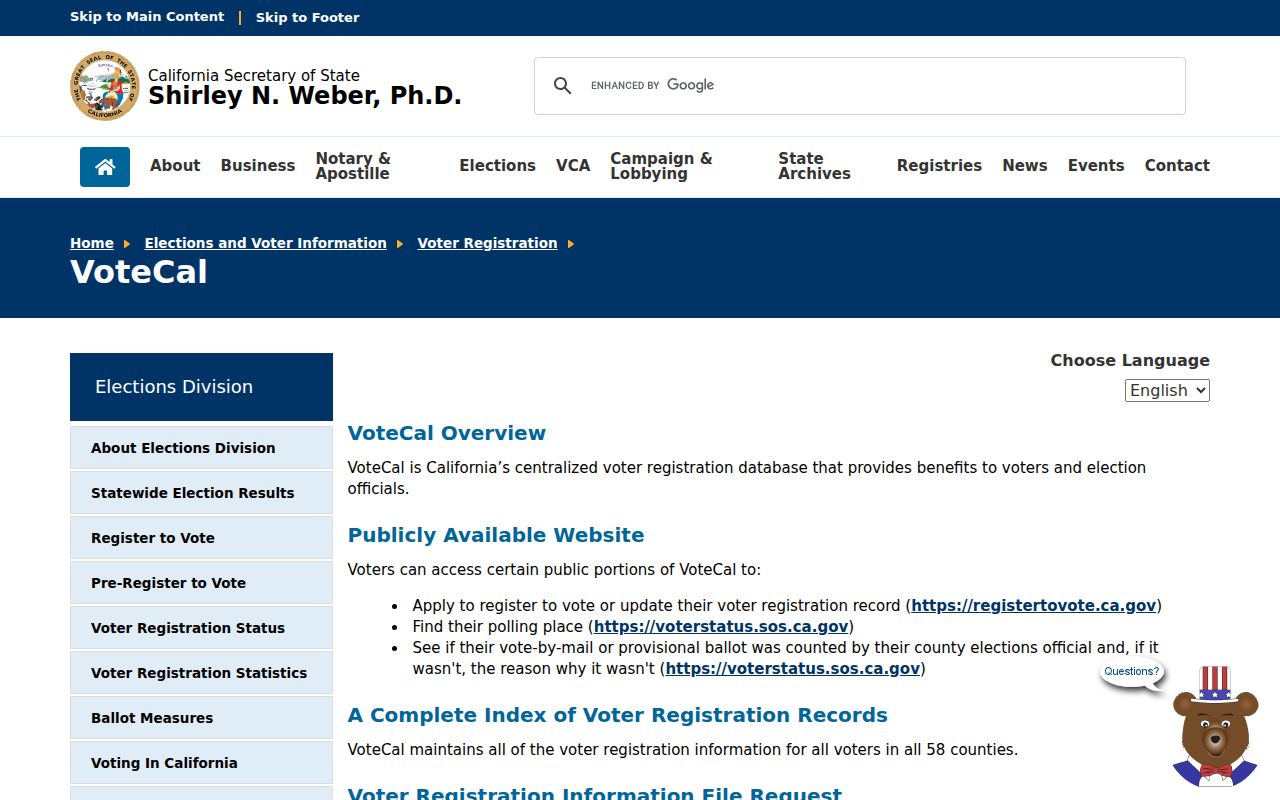
The overview helps separate the back-end statewide database from the secure self-service lookup available to a California voter.
Note: California has 58 county election offices, so a county-specific question still belongs with the office serving that voter's residence.
Fields in California Voter Records
An approved voter-file release can contain three linked data sets. The main registration data identifies the registrant and registration context. A participation file records whether and how the person took part in an election, not how any ballot was marked. A district file links precincts with political districts. The official field layout uses codes and IDs so recipients can join those files correctly.
| File or field group | What an approved release may show |
|---|---|
| Identity | Registrant ID, name parts, prefix, date of birth, gender, and place of birth. |
| Contact and address | Residential and mailing address fields, phone fields, and email, subject to confidentiality rules. |
| Registration | Status, registration date, method code, party code, language, and status-reason description. |
| Precinct and ballot | Precinct identifiers, assistance request flag, and vote-by-mail voter type. |
| Participation history | Election type, date, name, and participation method, never a voter's choices. |
| Political districts | District name, district value, and district type linked through a precinct ID. |
Anyone preparing or reading an approved data request should consult the Secretary of State's public voter data field layout. It defines the tab-delimited files rather than leaving column meanings to guesswork.
Note: District data links through precinct identifiers, so preserve the supplied file structure when reading an approved California voter extract.
California Withholds Protected Voter Data
Access to California voter records does not mean every registration field is released. Driver license and California ID numbers, the last four Social Security number digits, HAVA or unique voter identifiers, and voter signatures are excluded. Preregistration records for 16- and 17-year-olds are also withheld. Separate protections cover confidential voters under Elections Code sections 2166, 2166.5, 2166.7, and 2166.8.
Confidential by California law. Government Code section 7924.000 and Elections Code sections 2188 and 2194 limit release, while protected-voter laws keep specified records and identifying fields out of an ordinary voter-file disclosure.
The Safe at Home program adds an address-protection route for eligible survivors, threatened public workers, people affiliated with reproductive health care, and qualifying household members. Participants use a substitute mailing address with California state and local agencies. That protection is designed to keep a residential address from becoming public-facing when the program is used correctly.
AB 1392 Changes California Records
California added another precise voter-record boundary through AB 1392. Chaptered on October 3, 2025, the measure added Elections Code section 2166.9. Effective January 1, 2026, it makes the residence address, telephone number, and email address of elected officials and candidates confidential. The law also provides a process for journalistic and governmental access.
This rule changes the public and confidential split for a defined group. It does not turn all voter data private, and it does not make the My Voter Status tool a public search. A requester should account for these redactions before judging a file as incomplete.
Note: Redacted contact fields can reflect a current legal protection, not an error in the California voter registration data extract.
Requesting the California Voter File
The Secretary of State may approve voter registration information for candidates; committees supporting or opposing initiative or referendum measures; election, scholarly, journalistic, or political purposes; and governmental use as determined by the office. The governing authorities include Elections Code sections 2188, 2194, and 18109, Government Code section 7924.000, 2 CCR sections 19001 through 19013, and Business and Professions Code section 17538.41.
- Choose the scope. Request the statewide file from the Secretary of State, up to 10 specific voter records on one application, or a county file from that county's election official.
- Complete the voter file application. Include an original signature, a copy of a current driver license or state ID, proof of the authorized purpose, and payment.
- Mail or hand deliver the state request to Secretary of State, Elections Division, 1500 11th Street, 5th Floor, Sacramento, CA 95814. The office does not accept emailed or faxed applications.
- Allow 7 to 14 business days after receipt and review. Approved statewide, county, or district data arrives on encrypted DVD or in encrypted zipped files; specific records may arrive as an encrypted WinZip email attachment.
A statewide file costs $100. A specific record costs $30, with a $100 maximum per application. The request must give each person's name, date of birth, county of residence, residence address, and enough detail to support the reason. County-file fees vary by local election office.
The Secretary of State request page is the live source for forms, eligibility, fees, and submission rules.
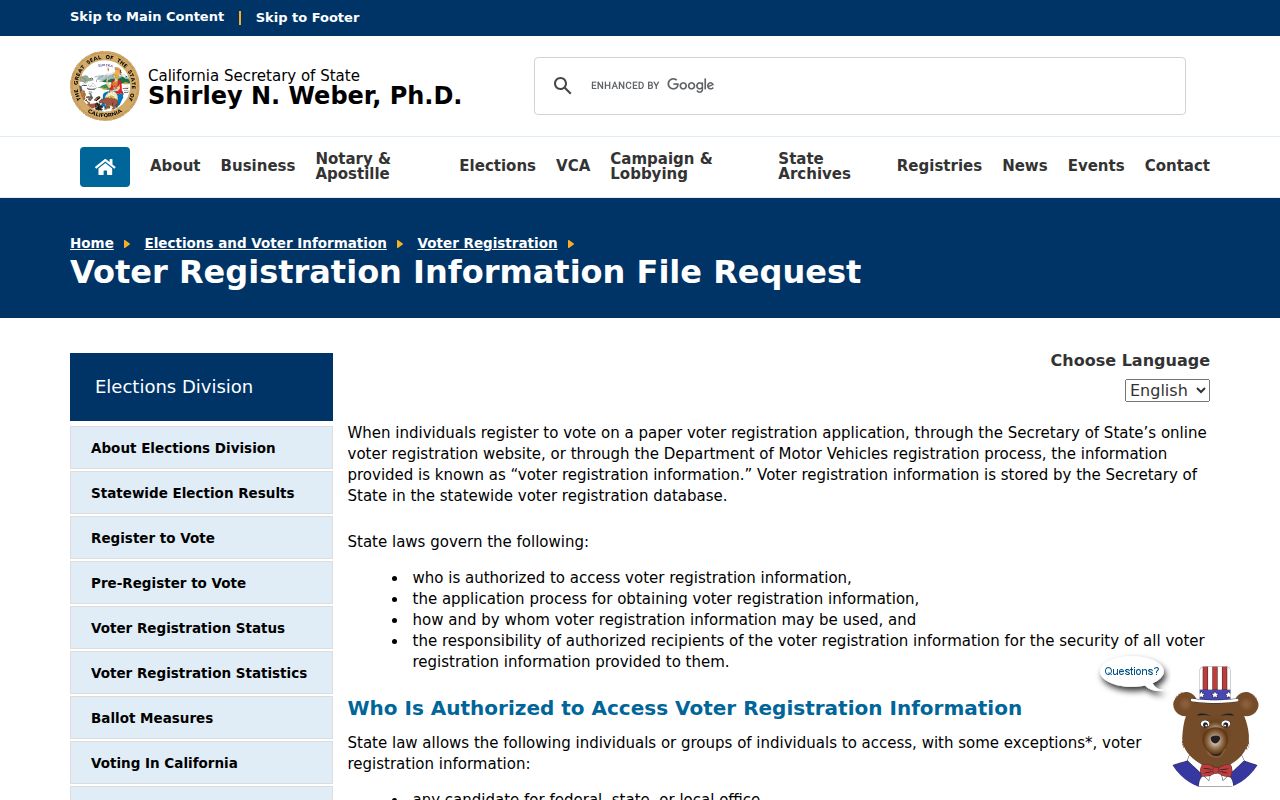
The request page reinforces that current voter rolls are controlled data releases, not open downloads for any stated purpose.
County Channels for California Records
County-specific voter files belong with the county election official, and the fee can differ by county. For a routine status problem, use My Voter Status first, then contact the county office named in the result. For a county data file, request the local office's current form, eligibility proof, price, and delivery method before sending payment.
The access chain is straightforward: secure state self-lookup, county election office for local voter help or a county file, Secretary of State for statewide or specific-record applications, then archives or libraries for historical rolls. General open-record rules are covered separately under California public records access; voter data has its own statutes and regulations.
California Voter Records Have Limits
An approval does not permit a recipient to reuse the file at will. California bars an unapproved purpose, an unauthorized share or transfer, commercial advertising or marketing, harassment of voters or their households, and unsecured public exposure online or offline. Elections Code section 18109 makes violations subject to misdemeanor penalties.
Use voter data only as approved. Do not post a file, pass it to an unauthorized person, market from it, or use it to threaten, track, or harass a voter or household.
These limits follow the data after delivery. Encryption protects the transfer, but the approved recipient must also keep the files secure and stay within the purpose stated on the application. When facts conflict, return to the election office that maintains the record rather than circulating a copy.
Note: Participation history can show that someone took part, but California voter records never disclose how that person voted.
Great Registers Preserve California Voters
For family history, California's Great Registers open a much older trail than the current voter file. The surviving county clerk registers span 1848 through 1921, with gaps that vary by county and year. FamilySearch notes that county poll lists gave way to registers known as Great Registers in 1866. Entries may place an adult resident in a county and may show residence, nativity or birthplace, and the registration era.
The first step is the California State Archives family-history collection. Archives holdings and FamilySearch coverage differ, so the fallback is the county clerk's historical records, a local library, or an archive serving that county. Search the county and likely year range, not just the name. Many older series lack a complete name index.
These voter rolls also carry a hard limit. Registration law once excluded many Californians, so absence does not prove that a person did not live in the county. Use a Great Register beside city directories, newspapers, probate files, and census material when building a family timeline.