
California Open-Record Landscape
California gives every person access to disclosable agency records under the California Public Records Act, Government Code section 7920.000 and following. That broad rule does not make every name-bearing file open. Each record set has its own keeper, search system, copy route, and limits. The table maps the chief channels before the county differences are examined in detail.
| Record Set | Keeper | Online Channel | Access |
|---|---|---|---|
| Deeds, liens, recorded documents | County recorder or clerk-recorder | Varies: Orange and San Diego index; none for Los Angeles | Index, counter, mail, or copy order; images vary |
| Superior court cases | Superior court in the filing county | County portal; statewide appellate search is separate | Remote index or register; some files only at court |
| Parcel and assessment rolls | County assessor, GIS, and tax collector | County portal, map, kiosk, or vendor | Public data; owner-name display differs by county |
| Birth, death, marriage, divorce certificate records | CDPH, local registrar, county recorder, or superior court | Forms and order pages, not a full public name index | Eligibility and record-type limits apply |
| Prison and jail custody | CDCR or county sheriff | CIRIS statewide for prison; county jail tools | Public locator fields; local update delays can occur |
| Agency documents | State or local agency that created or holds them | Posted files or agency request portal | CPRA request if not posted and not exempt |
Business entities, UCC liens, many license records, and unclaimed property have statewide searches. Deeds, trial cases, parcels, and jail bookings do not. Voter data is a distinct restricted record set, with its own request rules covered under California voter registration records.
Closed categories include sealed, juvenile, adoption, and confidential court files; protected voter information; Safe at Home address data; and personal information withheld by another law. An index result also does not promise a viewable image or certified copy.
California Recorder Access Varies
County recorders keep deeds, liens, reconveyances, notices, and other recorded instruments, but California has no statewide recorder index. Los Angeles County maintains real estate records from 1850. Its official recorder states that neither the records nor their indexes are available online. Access runs through an in-person search, an online copy order, or a mail request. Copy help is available at (800) 201-8999, and online orders are processed through LexisNexis, with the county reporting about 20 working days from receipt.
The Los Angeles County real estate records page shows that important online limitation.
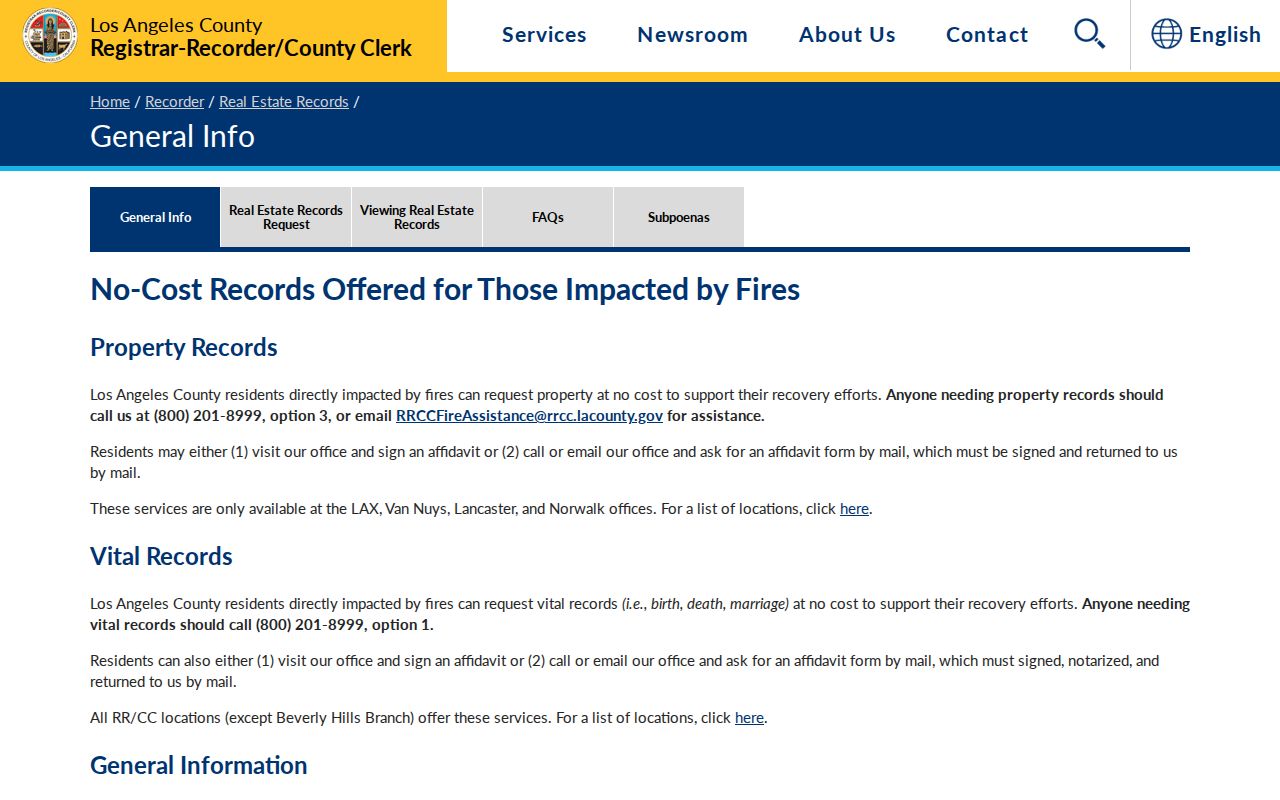
The screen is a useful warning: an official web page can explain access without supplying a searchable index. A failed name search should therefore lead to the recorder counter, copy service, or mail channel rather than an unofficial substitute.
Orange County takes a different route. RecorderWorks has a free grantor and grantee index for property documents recorded since 1982. Office copies cost $1 per page, and its cart supports a mail order sent to the Clerk-Recorder. San Diego's Official Records Index also accepts grantor or grantee searches, but users cannot view or print document images online. Purchased copies are printed the next business day and mailed, while newly recorded items may take about 24 to 48 hours to enter the index.
Note: A certified copy is the office-authenticated version needed when an ordinary print or index entry is not enough for legal use.
Orange County Record Index Fields
RecorderWorks illustrates how a detailed California county index works. A grantor is a party who gives or transfers an interest. A grantee receives it. The tool can also move beyond names when a document number, book and page, parcel number, or legal description is already known.
| Search Field | Input | Use | Format or Choice |
|---|---|---|---|
| Name role | Radio choice | Narrow a party's role | All, grantor, grantee, or both |
| Person or business | Text | Required for name mode | Last name first; business names accepted |
| Recording dates | Date pair | Limit the period | MM/DD/YYYY; portal range begins in 1982 |
| Document identifiers | Text | Find a known item | Document number or book and page |
| Document type | List | Limit the filing class | Deeds, liens, maps, defaults, reconveyances, and more |
| APN or legal description | Text | Connect a parcel to recorded documents | County parcel number or legal-description terms |
The results can show document number, recording date, document type, indexed party names, and party role. Duplicate names make those fields leads rather than proof of identity. Image viewing and copies remain an office or mail transaction, and a partial first name can help keep a broad surname search manageable.
California Court Records Stay Local
California has 58 superior courts and no single statewide trial-court party-name portal. Begin with the county where the case was filed. Then check that court's online index, register of actions, records department, clerk counter, courthouse terminal, or archive. Appellate search covers the Supreme Court and Courts of Appeal, not local trial files. A register of actions is the dated list of events in a case; it is not the same as the full pleadings and exhibits.
Rules of Court 2.503 and 2.507 permit electronic access in some form while restricting remote display for sensitive case types. An online result can show case title, party, party type, filing date, case number, activity, hearing date, department, and case type. It must omit items such as Social Security numbers, financial details, victim and witness data, warrants, ethnicity, and age. Divorce, custody, civil harassment, and criminal matters may expose only an index, calendar, or register remotely even when public documents can be inspected at court.
The Los Angeles Superior Court criminal name index displays its county search route.
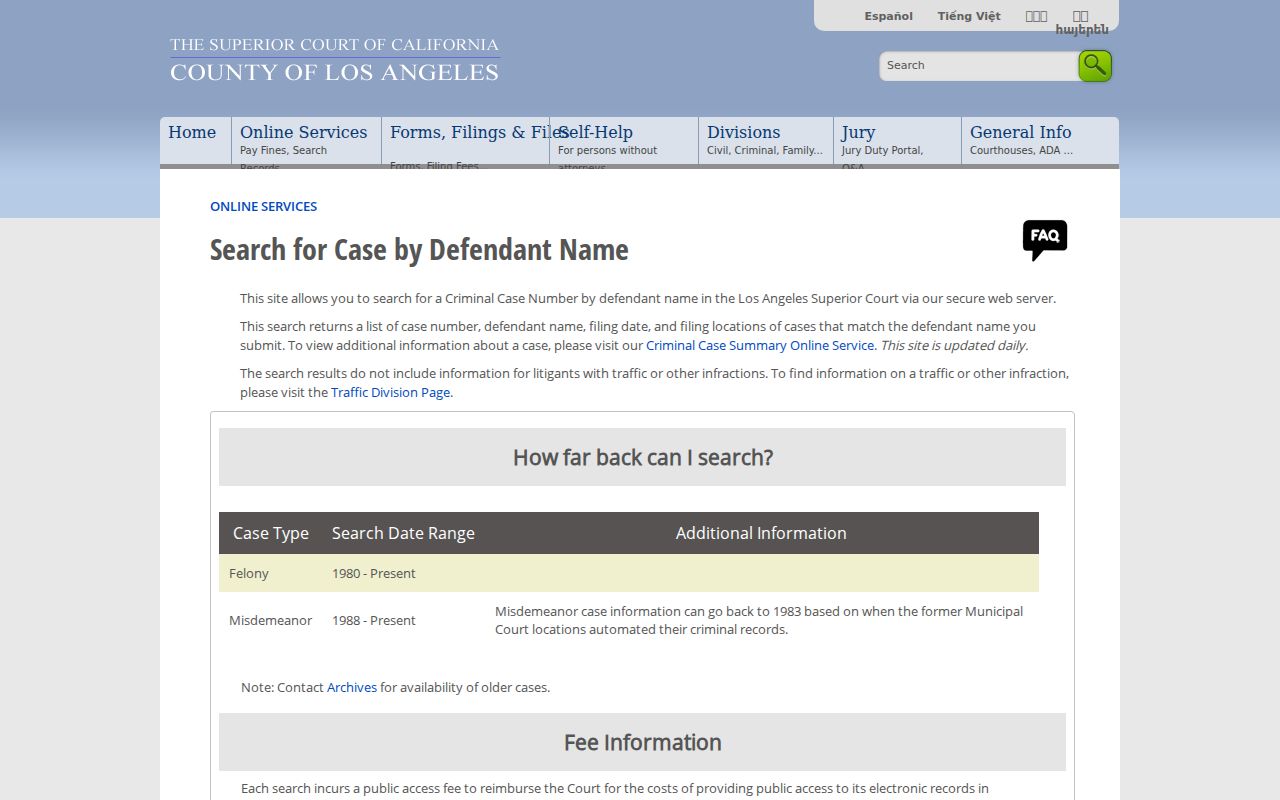
Los Angeles criminal coverage includes felonies from 1980 and misdemeanors from 1988, with some earlier automated records. Its separate civil index covers unlimited civil, probate, and family cases from 1983, limited civil from 1991, and small claims from 1992. Older matters go to Archives, while each online name search carries a public-access fee.
San Diego's party search spans civil, criminal, domestic, mental health, and probate cases. Older indexes offer an unusually deep fallback: hardbound books cover 1880 through 1964, followed by computer-generated indexes. That history matters when the current portal stops short.
California Vital Record Boundaries
CDPH-Vital Records maintains statewide birth and death records from July 1905 and selected marriage and divorce certificate records. County recorders and local registrars issue records for events in their counties and may be faster. The channel is an application and copy order, not an open statewide name index. CDPH mails accepted requests by First Class Mail and may issue a Certificate of No Public Record when no match is found.
Authorized certified copies can establish identity and require an eligible relationship plus a notarized sworn statement. Informational copies preserve core family facts but are marked as not valid to establish identity and may redact some items. This distinction lets family researchers request useful information without treating every certificate as freely open.
- Birth copies cost $31 through CDPH in 2026.
- Death copies cost $26.
- Marriage copies cost $19, but CDPH has a 2000 through 2007 gap.
- Dissolution certificates cost $18 and cover only 1962 through June 1984.
- County offices may offer a quicker route for local events.
CDPH's dissolution record is not a divorce decree. It reports the parties, filing date, county, and case number. The superior court in the divorce county holds the decree. Confidential marriage copies are available only from the issuing county clerk and only to the two named parties.
Copy warning. CDPH reported average certified-copy processing of 5 to 7 weeks and does not refund an accepted fee merely because no record is found.
California Property Records Connect Systems
Property research crosses several custodians. The assessor roll identifies the parcel and assessed property, the recorder index shows recorded transfers and liens, GIS draws parcel boundaries, the tax collector handles bills, and local permit offices keep project records. An APN, or assessor parcel number, is the county's parcel identifier. It is not unique statewide, so the county must stay attached to it.
The Los Angeles County Assessor property-search page opens the official address and AIN route.
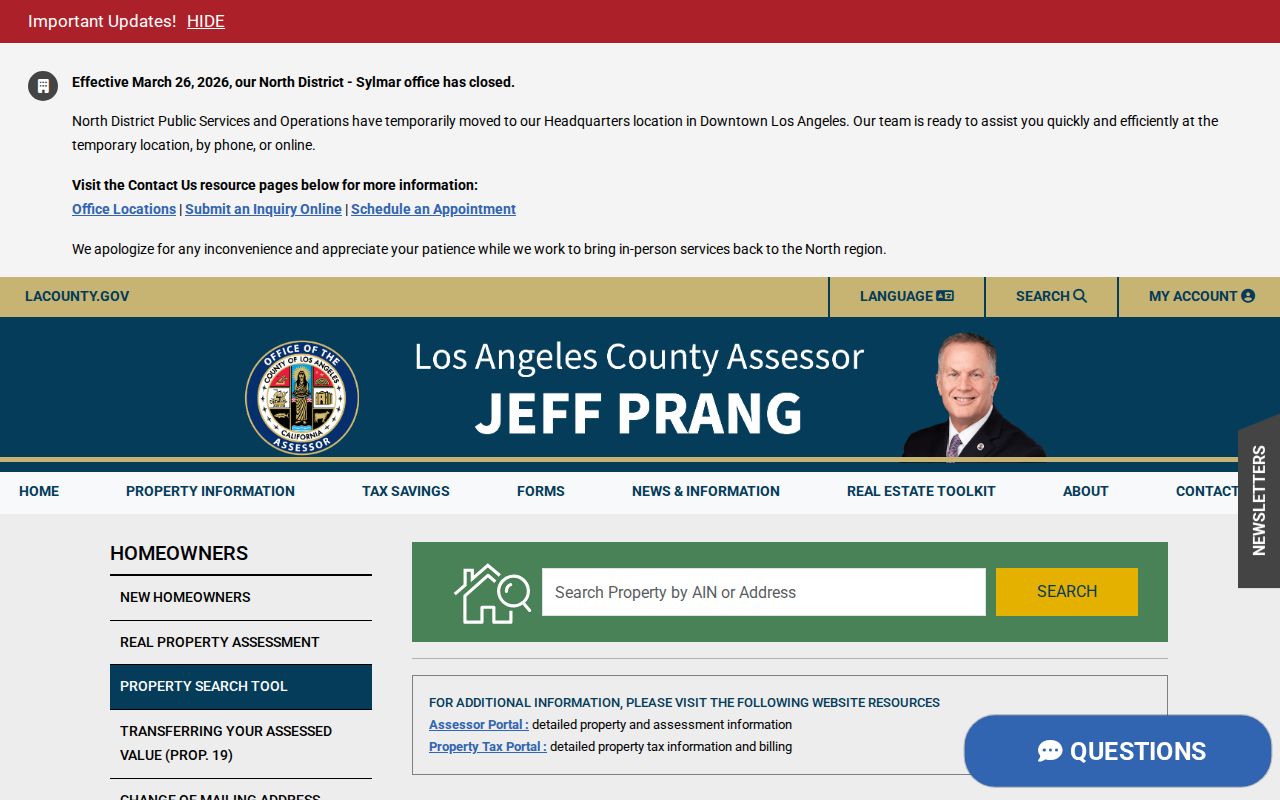
The assessor path connects an address to parcel data, maps, and legal-search tools. It does not replace the recorder's deed index, and a map is not a legal survey.
San Diego shows the full fallback chain. ParcelQuest supplies APNs, property characteristics, and assessor-map access, with up to 25 free searches in 30 days. Ownership and address information can also be requested by phone at (619) 236-3771 or viewed on a public kiosk. Copies cost $2 for the first page and $0.05 for each added page. Its more than 29,128 assessor maps depict almost 1,001,029 parcels, yet the maps themselves do not show street addresses or owners. The APN bridges the map to the ownership channel.
California Records Custodians and Portals
These offices show how statewide and county duties divide. Contact the holder of the actual record. DOJ cannot fetch another agency's files, the Judicial Council does not supply county case records, and CDPH cannot issue a confidential marriage certificate.
CDPH Vital Records
P.O. Box 997410
Sacramento, CA 95899-7410
(916) 558-1784
Vital Records hub
Los Angeles County Recorder
12400 East Imperial Highway, Room 1002
Norwalk, CA 90650
(800) 201-8999
San Diego County ARCC
Recorder and Clerk channels
Countywide service
(619) 237-0502
Use the CDPH county registrar and recorder directory when another county holds the event. For agency documents, identify the department's own records officer rather than sending a broad request to the state.
California Custody Records Split Three Ways
State prison, county jail, and sex-offender information come from different custodians. CDCR's CIRIS returns a current incarcerated person's name, CDCR number, age, location, commitment counties, admission date, and some parole-hearing data. It does not contain county jail bookings. Those belong to each sheriff, such as the Los Angeles County Inmate Information Center. California VINE adds custody status and notification options for participating agencies, with the facility as the fallback during an interruption.
The California Megan's Law registry publishes only information that law permits DOJ to disclose. Users must accept a disclaimer before searching, and not every registrant appears publicly. The data is updated by law-enforcement agencies, so a result can change.
Registry information exists for public protection. Harassment or criminal misuse can bring civil or criminal consequences. A no-match also does not prove that a person has no relevant record because disclosure rules and update timing shape each database.
California Records That Stay Protected
Open-record law works alongside privacy and confidentiality statutes. California courts seal or close juvenile, adoption, and other protected cases. Electronic court indexes exclude highly sensitive identifiers. Voter files omit driver license and state ID numbers, partial Social Security data, signatures, preregistration records, and protected-voter information.
Safe at Home gives eligible survivors, threatened public workers, reproductive-health-affiliated people, and qualifying household members a substitute mailing address for use with public agencies. Proper use helps keep a residence out of public-facing files. DMV personal information is separately restricted by federal law, while vital-copy eligibility controls identity-bearing certificates.
Data-broker deletion is another system. California's DROP platform launched for consumers in January 2026, with broker processing set to begin August 1, 2026. It can direct registered brokers to delete and stop selling covered data. It does not erase an official deed, court index, or agency record from its government custodian.
Note: Redaction hides protected fields while leaving the disclosable part of a record available.
California Records Terms Decoded
Access depends on the form of the item as much as its subject. These terms explain why a portal result, a file view, and an official copy may lead to different fees and channels.
- Custodian
- The agency, court, or county office that holds and controls the requested record.
- Index
- A searchable list of names, dates, numbers, and record types. It may not include the underlying image.
- Certified copy
- A copy authenticated by the issuing office for uses that require official proof.
- Register of actions
- The court's dated event list for a case, often available when full documents are not remotely displayed.
- Exemption
- A legal ground that permits or requires an agency to withhold all or part of a record.
Ask whether the need is an index search, inspection, ordinary copy, or certified copy. That one choice often determines whether the next step is free online access, a courthouse terminal, a mail order, or a paid office copy.
California Records Rules in 2026
Several recent changes affect access. AB 370, enacted in 2025, added a cyberattack-related unusual circumstance to CPRA timing when an agency cannot reach electronic systems, with limits if the same record remains available elsewhere or in paper form. It did not create an unlimited delay.
AB 1524 requires public electronic trial-court records to remain viewable at court even if they are remotely available. It also permits public users to photograph or copy accessible court records at court with their own non-contact equipment without a reproduction fee, subject to stated limits. The change strengthens the courthouse channel rather than turning sensitive files into unrestricted remote records.
CDPH certified-copy fees rose on January 1, 2026 under AB 64. DROP also opened in January, and data brokers must begin processing its deletion requests in August. Together these updates show two different directions: public custodians still charge record-specific copy fees, while privacy law gives residents a wider path to reduce brokered copies of personal data.
File a California Public Records Request
The CPRA covers identifiable records held by state and local agencies unless an exemption applies. It does not require staff to create a new record, conduct research, or compile facts that do not exist in a responsive file. A focused request names the office, subject, date span, record type, and preferred electronic or paper format.
- Confirm the keeper. Send court files to the filing court, deeds to the county recorder, and agency documents to the agency that holds them.
- Check posted access. Use the official index, reading room, courthouse terminal, or posted dataset before asking staff to duplicate it.
- Describe the records. Give names, dates, subjects, offices, case or document numbers, and a practical date range. Ask staff to help clarify a request that is too broad.
- Submit through an accepted channel. Use the agency portal, web form, email, mail, or in-person process. Vital records and voter files use their own forms instead of a general CPRA request.
- Review the response and cost. An agency normally determines within 10 days whether it holds disclosable records. A written extension of up to 14 days can apply in unusual circumstances.
- Narrow or challenge if needed. Ask for the exemption cited, seek segregable nonexempt portions, refine an overly broad request, or use the agency's review path.
The Los Angeles RR/CC request portal is one county example of the online submission channel.
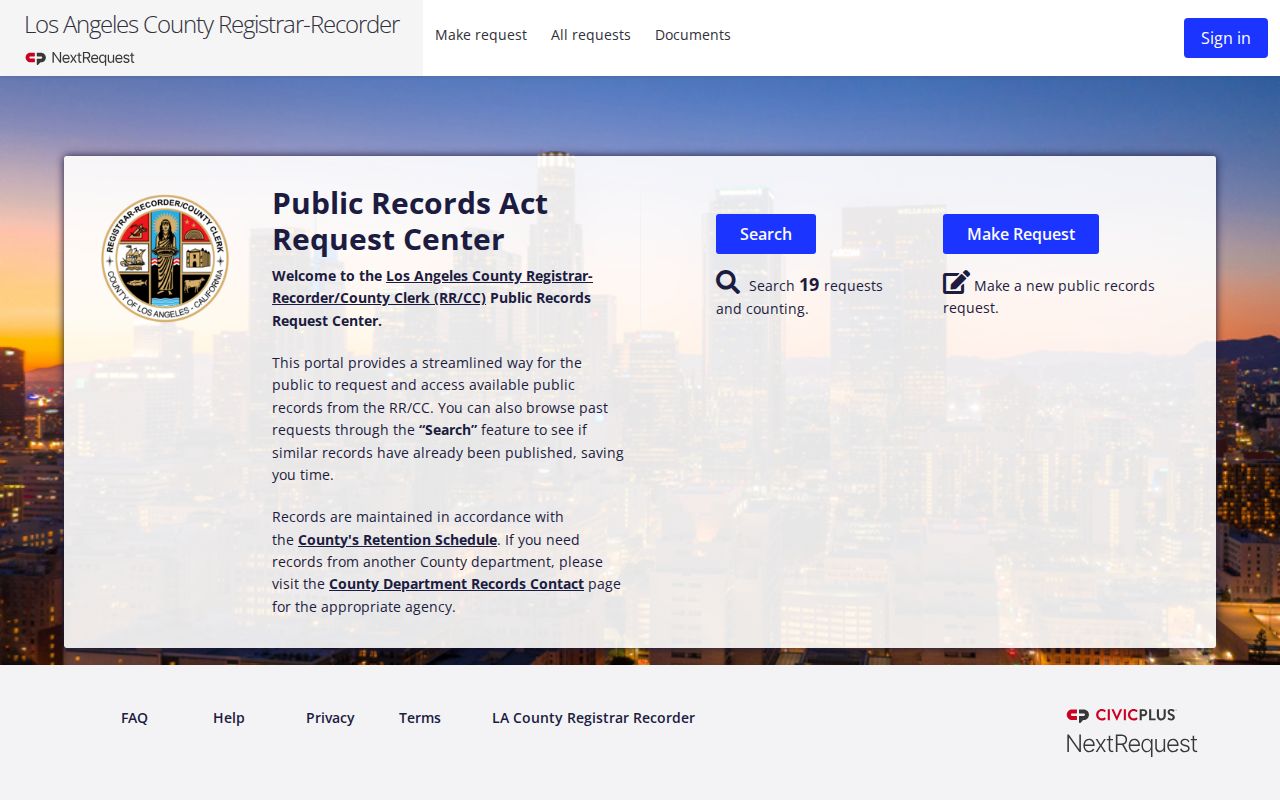
The form routes requests to the county custodian and preserves a request trail. Los Angeles real estate copy orders still use the recorder's separate copy service, which shows why the exact record type matters.
Fees are generally limited to direct duplication costs or a separate statutory charge. California DOJ lists 10 cents per page and may charge full extraction or programming costs when a request requires electronic data work. Inspection can avoid copy fees, but it does not override a lawful exemption.
Lawful personal use. Use open records for legitimate family, estate, consumer-safety, property, and civic research. Never use a name, address, custody record, or registry entry to stalk, harass, threaten, or harm anyone.