
Build a California People Search
Start with the part of California tied to the person. County context matters because deeds, parcels, jail bookings, and trial court cases do not sit in one statewide index. State systems work well for professional licenses, business filings, prison custody, unclaimed property, appellate cases, and a voter's own registration status. County recorders, assessors, courts, sheriffs, and elections offices carry the local layer.
A name can lead to a license or court index. An old address may work better in a parcel roll or reverse directory. For family history, begin with vital indexes and local archives, then request the right copy from CDPH or the county. Keep a record of spellings, dates, counties, parcel numbers, and case numbers as each search returns them.
- Choose the likely county and check its assessor, recorder, and superior court tools.
- Use statewide license, business, custody, and unclaimed-property searches to test the name broadly.
- Turn an address into an assessor parcel number, then use that number in maps and deed indexes.
- For an older trail, search city directories, newspapers, Great Registers, probate files, and vital indexes.
- When no portal exists, contact the custodian by counter, mail, copy order, or records request.
Use records lawfully. California lookup tools must not be used to stalk, harass, intimidate, or harm a person.
California People Records Custodians
California's records offices divide work by record type. CDPH-Vital Records handles statewide certified birth and death copies from July 1905 forward and certain marriage and divorce records. The California State Archives holds selected historical state and local series, including records from 28 counties. The Secretary of State maintains business, UCC, voter, archives, and Safe at Home functions. County recorders and assessors remain vital because no state portal replaces their deed and parcel systems. Detailed access rules belong with the California public records system.
CDPH Vital Records
MS 5103, P.O. Box 997410
Sacramento, CA 95899-7410
(916) 558-1784
California State Archives
State and selected county collections
Onsite and microfilm research
Family history resources
Secretary of State
Business and UCC filings
Statewide online searches
bizfile Online
California Recorder Search Gaps
The county layer changes the search experience. Los Angeles County keeps real estate records dating to 1850, yet its recorder does not provide official online access to the index. The public must use an in-person search, a mail request, or the county's online copy-order channel. Orange County RecorderWorks does provide a grantor and grantee index for property documents recorded since 1982. A grantor transfers an interest; a grantee receives it.
RecorderWorks accepts names, document numbers, book and page, dates, document types, maps, parcel numbers, and legal descriptions. A partial first name can prevent a broad last-name query from timing out. Its index is free to search, while legal use may require a certified copy.
| Search field | What it narrows | California use |
|---|---|---|
| Grantor or grantee | Party role and name | Find deeds, liens, and transfers |
| Date range | Recording period | Separate people with the same name |
| Document type | Deed, lien, map, or notice | Focus on the event being traced |
| APN | Assessor parcel number | Join parcel and deed records |
The Orange County search screen shows how many ways a California recorder index can be queried.
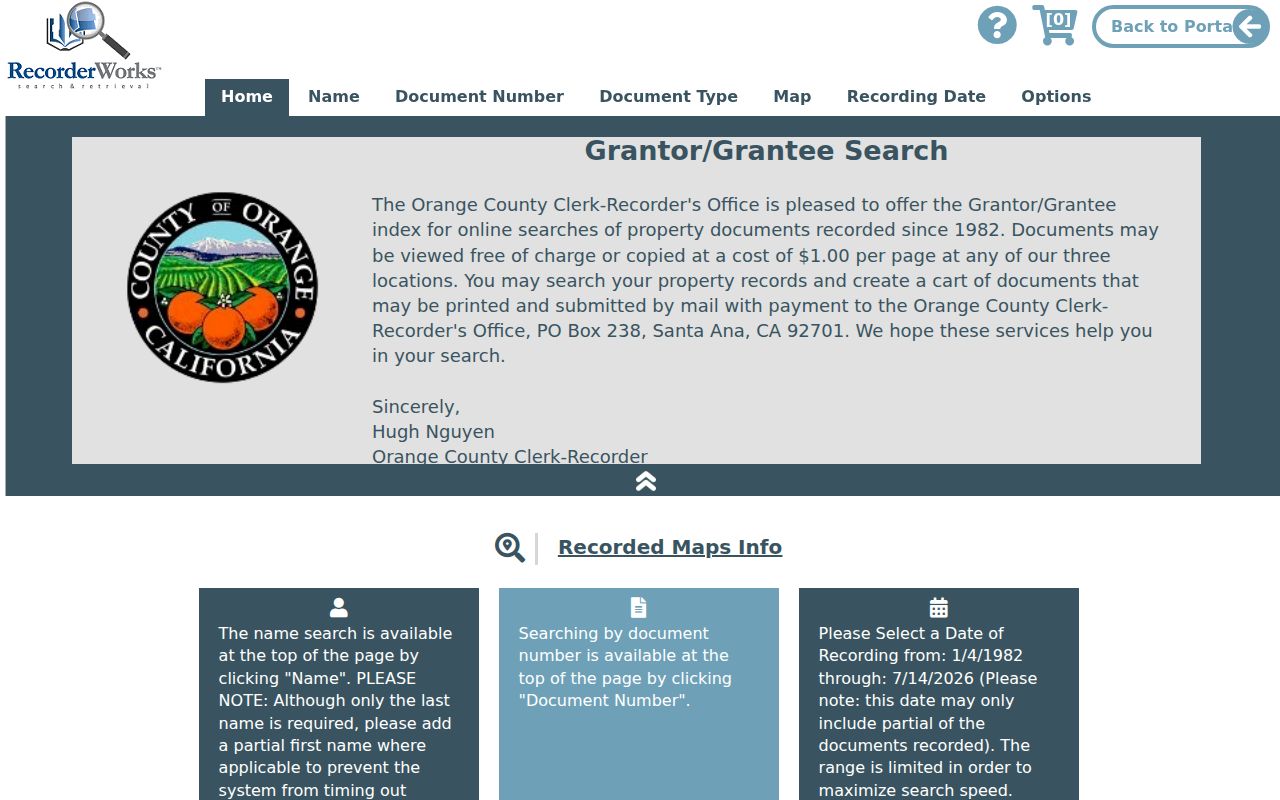
Those fields also show why a statewide name-only search cannot replace county context.
California Property Search Trails
Property records can turn a street address into a name or connect a known owner to a mailing address. The assessor roll, recorder index, tax system, GIS map, and building records are separate channels. A situs address is the physical parcel location. A mailing address is where tax notices go, and may be more useful when an owner lives elsewhere. An APN is the county assessor's parcel identifier, not a statewide number.
Los Angeles County's assessor portal accepts an AIN, its term for an APN, or an address. San Diego makes ownership and address details available through phone and public kiosks, while ParcelQuest provides online parcel data with a free-search limit. Assessor maps show parcel lines and references, but they are not legal surveys.
The Los Angeles County Assessor Portal illustrates the address and parcel entry points.
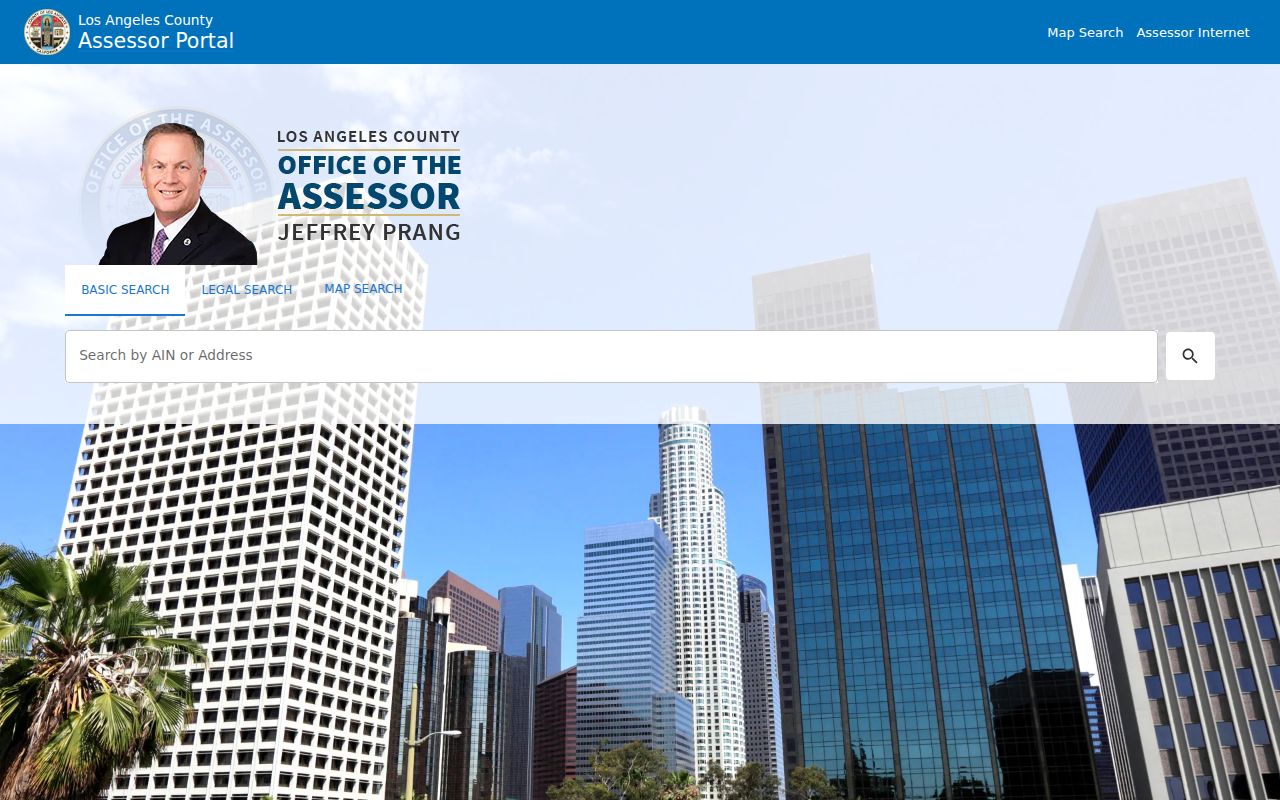
Once an AIN is known, the same parcel can be checked in map and recorder channels.
Note: Always keep the county with an APN because California counties can reuse similar number patterns.
Search California Court Names
California has 58 superior courts and no single statewide trial-court party search. Each county controls its own portal, terminals, clerk counters, and archives. Remote access also depends on case type. Public indexes may show a case title, party name and role, filing date, case number, event dates, and a register of actions. A register of actions is the court's dated list of filings and events. Sealed, juvenile, adoption, and other confidential files remain closed.
| Court route | Records covered | Search path | Fallback |
|---|---|---|---|
| Los Angeles Superior Court | Civil, family, probate, small claims | Paid litigant index | Archives or courthouse |
| San Diego Superior Court | Civil, criminal, domestic, mental health, probate | Party Name Search | Records office or archive |
| California appellate courts | Supreme Court and Courts of Appeal | Statewide appellate search | Appellate clerk |
| Federal courts | District, bankruptcy, appellate | PACER | Federal clerk |
The Los Angeles civil index demonstrates a paid county party search.
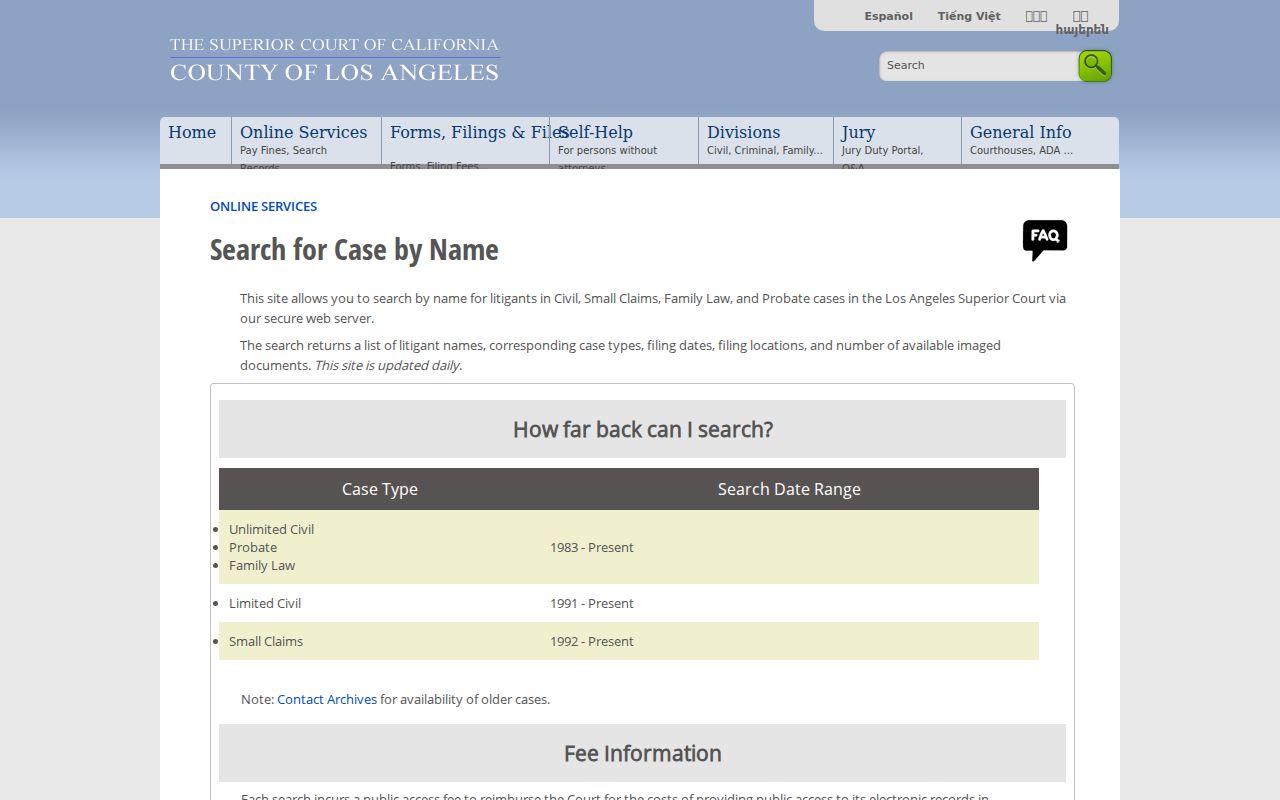
Its date coverage varies by case type, so older matters must move to Archives.
The San Diego Court Index uses name, case type, location, party role, year, and optional birth date.
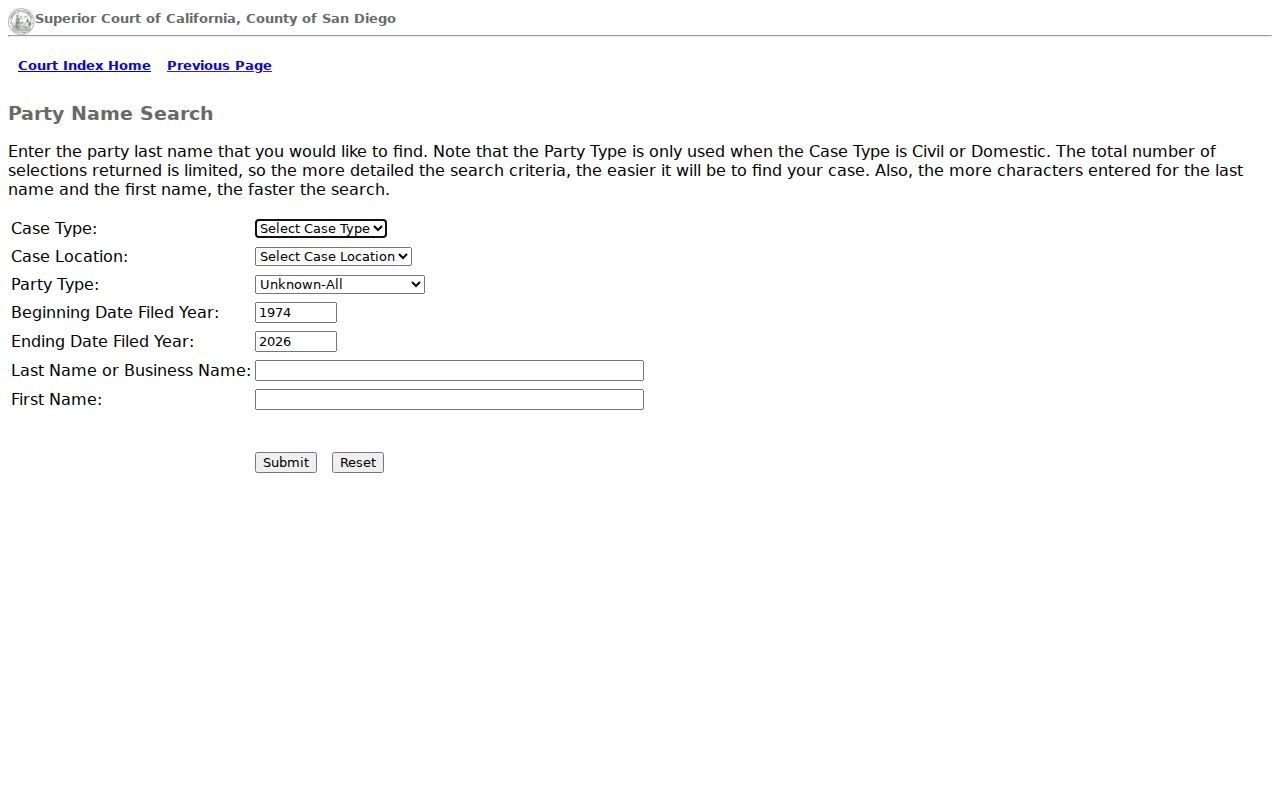
This county contrast is a practical reminder to read each court's own coverage and access rules.
Trace California Vital Records
CDPH keeps statewide birth and death records from July 1905 forward. County recorders and local registrars also issue records for events in their counties and may be faster. An authorized certified copy can establish identity and requires an eligible requester plus a notarized sworn statement. An informational copy contains the same core facts but cannot establish identity and may redact some items.
Marriage and divorce routes have sharp limits. CDPH cannot issue certified marriage copies for 2000 through 2007, and confidential marriage copies come only from the county clerk that issued the license and only to the parties. CDPH's 1962 through June 1984 divorce product is a certificate of record, not a decree. The decree must come from the county superior court. Historical researchers can use county marriage collections, death indexes, cemetery records, and local registers before seeking a certified copy.
- Certified copy
- An official copy issued by the custodian, with eligibility rules depending on record type.
- Informational copy
- A marked copy useful for family facts but not valid to establish identity.
- Index
- A finding aid that points to a record; it is not the record image or a certified copy.
California License Name Searches
Occupation can be a strong way to separate people with common names. The DCA License Search covers many regulated professions and accepts a first name, last name, license number, business name, board, license type, city, county, and state. Results may show the license number, type, current status, and public discipline. Some boards maintain their own tools, so DCA is not a complete list of every licensed field.
The DCA advanced form presents the statewide search fields in one place.
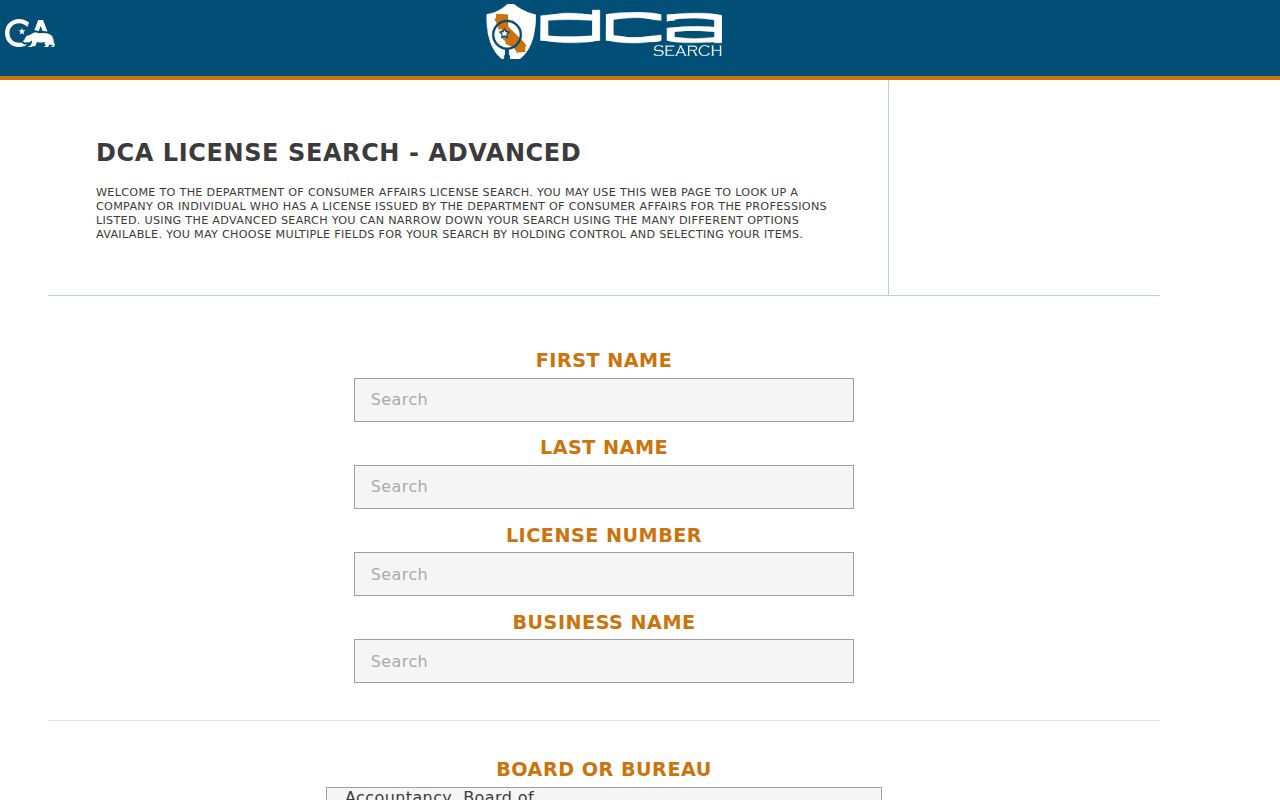
A city or county filter can reduce false matches before a board record is opened.
The State Bar advanced search adds firm, district, county, specialty, language, and self-reported practice filters.
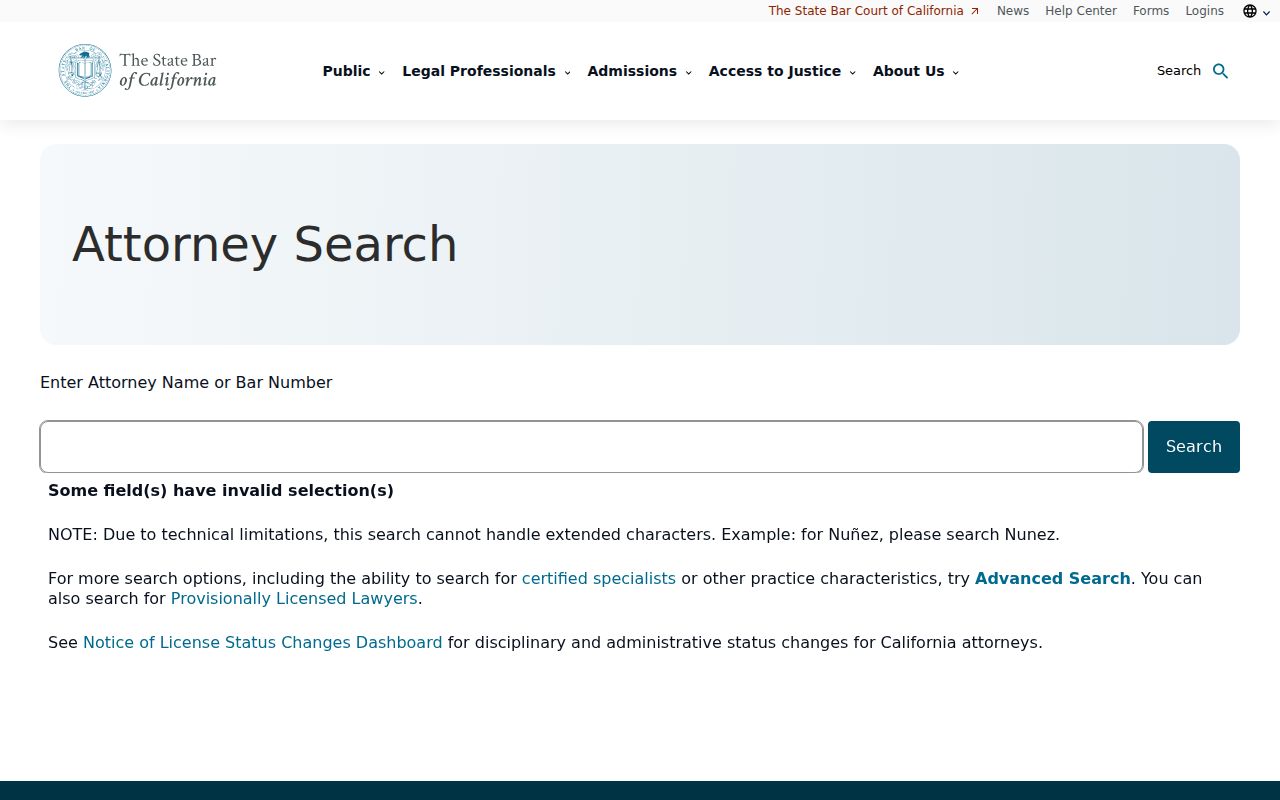
Bar records can connect a name to a public professional address, admission history, status, and discipline where published.
California Business Filing Lookup
Business names, registered agents, managers, public addresses, and filing history can connect a person to an entity. The Secretary of State's bizfile Online search covers corporations, limited liability companies, and other registered entities. Its separate UCC search can be queried by debtor, secured party, or filing number. UCC filings are lien notices and should be read as filing records, not proof of a person's current home address.
The official business search is a better source for entity status than a copied commercial listing.
Open the entity record and note the filing dates and roles before deciding whether a same-name match is relevant.
California Custody Search Boundaries
California custody information is split by jurisdiction. CDCR CIRIS locates people in current state prison custody and may return a name, CDCR number, age, location, commitment county, admission date, and parole hearing information. It does not cover county jail bookings. Those searches must go to the county sheriff, such as the Los Angeles County Inmate Information Center.
The CIRIS interface is the state-custody entry point.
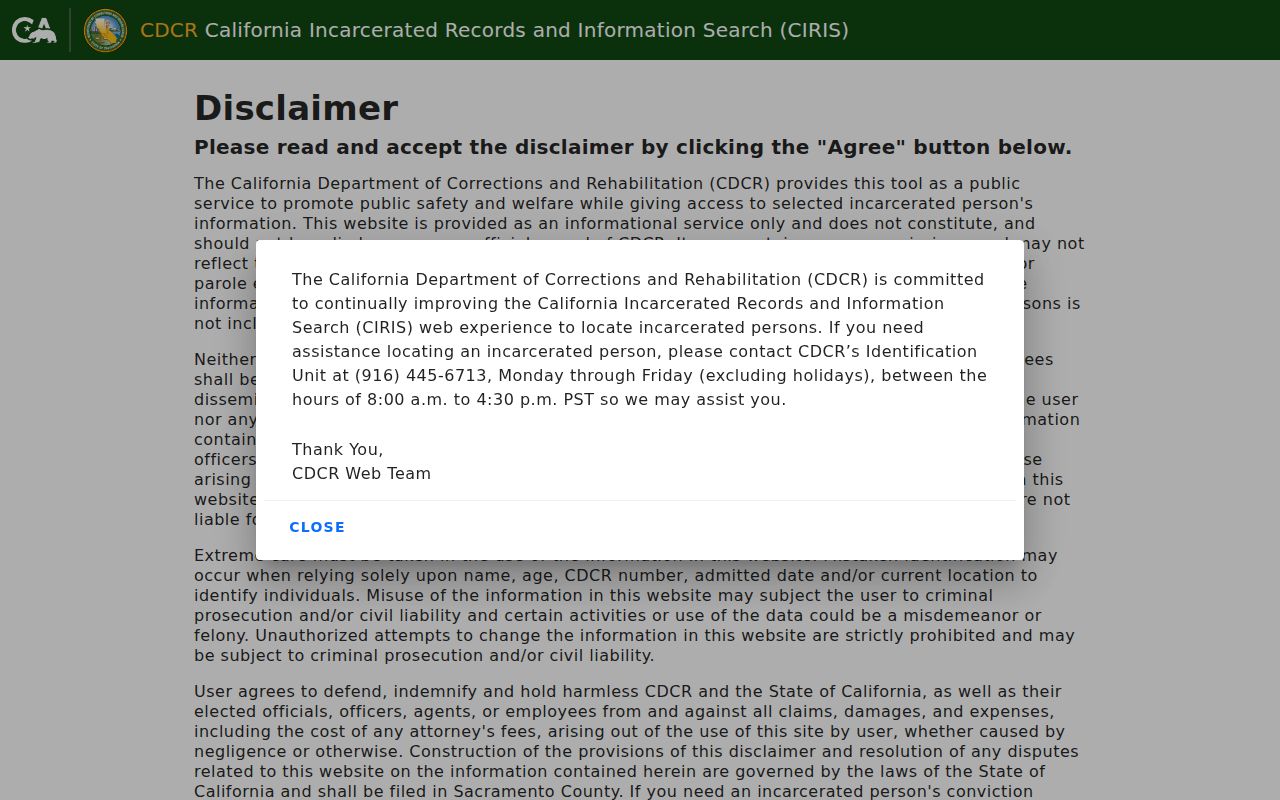
A no-match result should prompt a county jail check, not a conclusion that the person is not in custody.
The California Megan's Law registry has a different public-safety purpose and requires acceptance of a disclaimer.
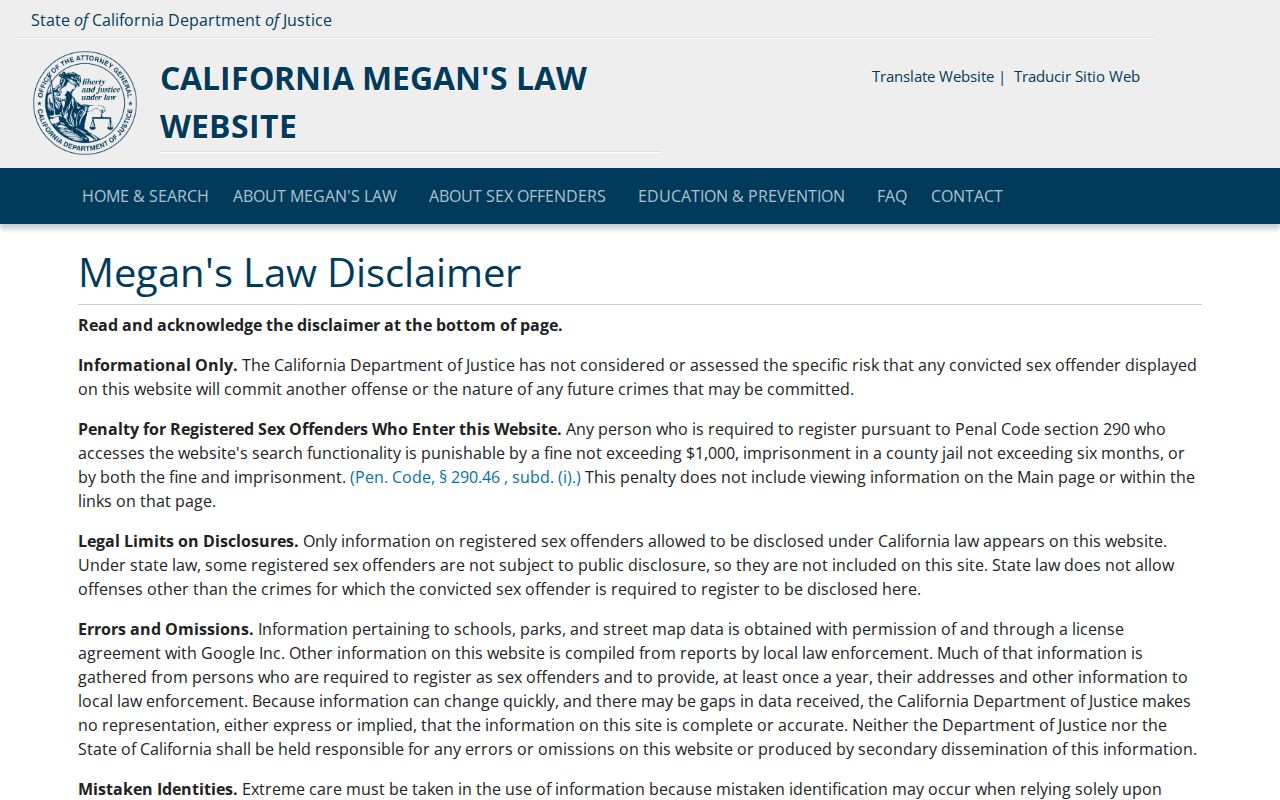
Not all registrants are publicly displayed, data changes, and misuse may lead to criminal prosecution or civil liability.
California Unclaimed Property Names
The State Controller's ClaimIt search can surface a reported owner or payee and a location tied to abandoned property. It is useful when other official records are stale because banks, insurers, and other holders report property to the state. California charges no state fee and imposes no deadline to claim, so requests for an upfront state charge should be treated with care.
The ClaimIt screen offers the official free starting point.
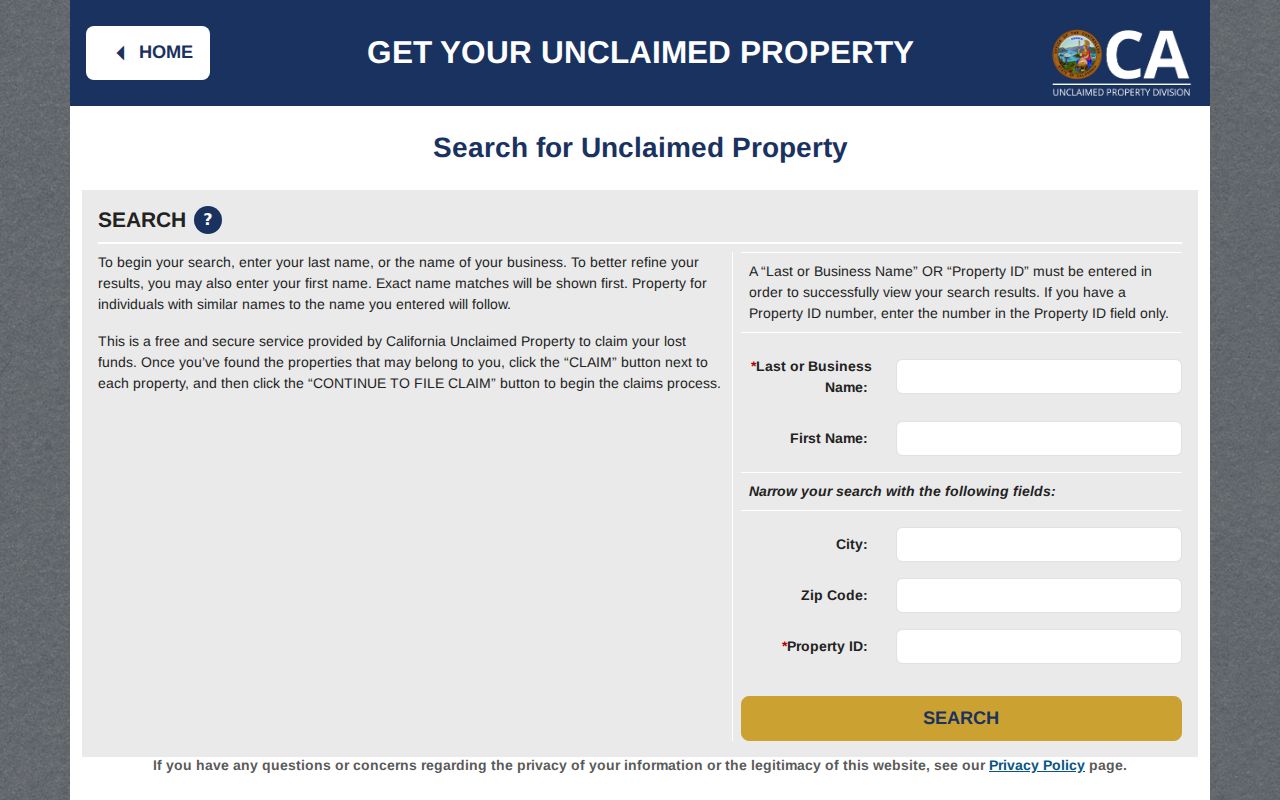
Downloadable unclaimed-property records offer another official channel when an app search is not enough.
California Voter Lookup Limits
My Voter Status is an authenticated self-lookup, not a public people finder. A voter supplies a registered first and last name, birth date, and identity fields to check registration, party and language preferences, ballot status, polling place, county elections office, and election links. The full voter file follows strict eligibility, application, fee, security, and use rules. Historical Great Registers are different: county voting registers from 1848 through 1921 can support genealogy where county and year coverage survives. The California voter records page separates these access paths.
California Archives Preserve Names
California's archive system begins with an unusual records story. The 1850 Act Concerning the Public Archives was the first law signed by the state's first governor. Today, the State Archives holds selected county court, probate, naturalization, deed, Great Register, prison, military, veterans-home, and early licensing material, but it is not the official vital-record counter.
Libraries extend the trail. LAPL offers digitized Los Angeles city and street directories from 1875 through 1987. SFPL combines city, reverse, and phone directories with obituary tools, funeral-home files, medical examiner records, voter registers, social registers, and yearbooks. The California Digital Newspaper Collection and Online Archive of California help identify a collection before an onsite request. When a modern portal ends, place, date range, record series, and former spelling often matter more than a broad name query.
Choose California Search Sources
Official California records and commercial people-finder reports serve different roles. An official portal is tied to one custodian and one record system. Its limits are often clear: a recorder index may omit images, an assessor map is not a legal survey, and a court portal may send older cases to an archive. The narrow scope helps a reader judge what the result proves. A commercial report may combine many sources, but copied data can be stale, merged with a same-name person, or detached from the county and date that gave it meaning.
Use a compiled report, if one is consulted at all, as a lead rather than authority. Confirm each useful fact with the agency, court, library, or archive that keeps the source record. This matters with common names and old addresses. A current license status, a recorded deed, and a historical directory entry describe different moments and should not be treated as one current profile.
| Source choice | Best use | Main limit |
|---|---|---|
| Official online index | Check a named record system quickly | May exclude images, older years, or sensitive cases |
| Custodian copy | Obtain the record or certification offered by the office | Fees, eligibility, and processing time can apply |
| Courthouse or office terminal | Reach records not available remotely | Requires an in-person visit and may still exclude closed files |
| Library or archive | Trace old residents, addresses, estates, and local history | Coverage may be partial, onsite, or not name indexed |
| Commercial compilation | Generate leads across mixed sources | Accuracy, age, source detail, and lawful-use controls vary |
Free access does not always mean a full record. Orange County lets users search its recorder index at no charge, yet a certified document follows a separate copy path. Los Angeles provides copy-order and counter channels without an official web index. California court searches can charge a public-access fee or limit remote detail by case type. Compare the needed proof with the channel before paying or drawing a conclusion.
California Privacy Tools Differ
Official records and brokered profiles follow different removal rules. California residents can use CCPA and CPRA rights with covered businesses, while DROP lets a resident send one deletion request to active data brokers. DROP launched for consumers in January 2026, and broker processing begins August 1, 2026. These tools do not erase a deed, court index, or other official record at its government source.
Safe at Home serves eligible survivors, threatened public workers, reproductive-health-affiliated people, and household members through a substitute mailing address accepted by state and local agencies. Voter identifiers, signatures, protected-voter records, and certain contact fields are confidential. Court indexes also omit sensitive financial, victim, witness, warrant, and identity details. Respecting those boundaries is part of a sound California search.